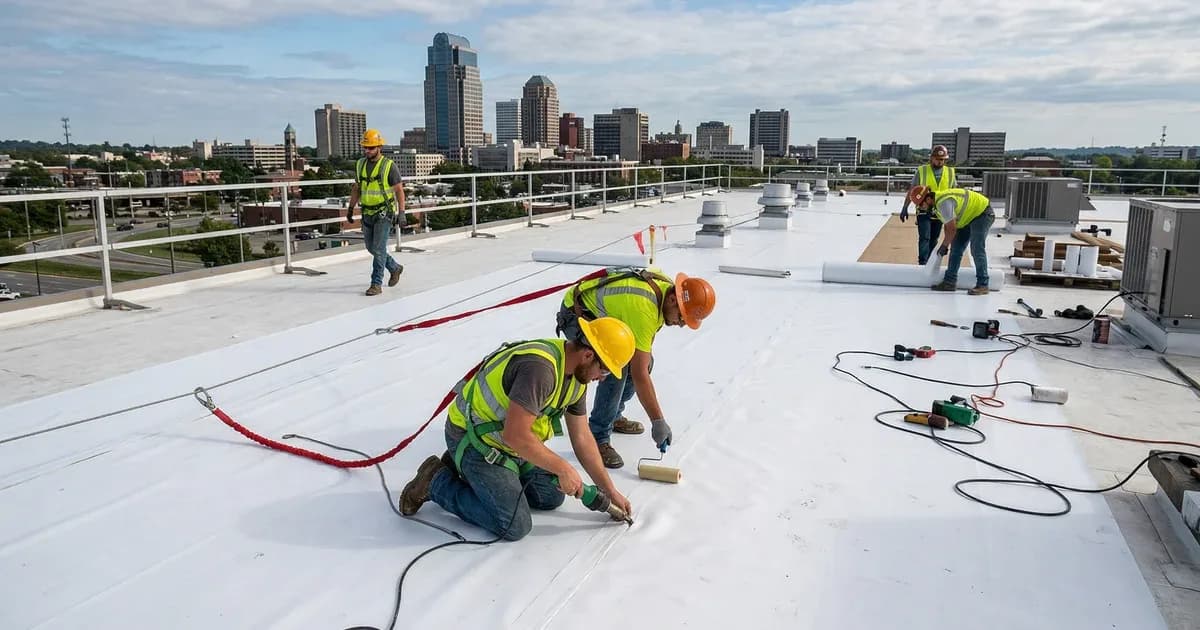
Commercial roofing decisions affect more than curb appeal. The right contractor protects tenants, inventory, schedules, and long-term operating costs. If you are comparing options in Lexington, start with the fundamentals before you sign a proposal.
1. Verify licensing, insurance, and safety practices
A commercial roofing team should be able to explain licensing, insurance coverage, and jobsite safety expectations without hesitation. That matters because roof work can expose your business to liability when the contractor is not properly prepared.
Ask for proof of coverage, ask who supervises the crew, and confirm how weather delays or active-building conditions are handled. A contractor who is organized up front is more likely to run a controlled project once the work begins.
2. Look for commercial-specific experience
Commercial roofing is not the same as residential repair work. Drainage design, penetrations for mechanical systems, staging around occupied spaces, and coordination with other trades all raise the difficulty level.
When you talk with a contractor, ask about:
- Similar roof systems they have installed or repaired
- Occupied-building projects they have managed
- How they phase work to reduce disruption
- Whether they can coordinate with HVAC, electrical, or framing crews
For larger renovation scopes, it also helps to work with a contractor that understands broader building systems. Handy Manny's LLC handles roofing as part of full commercial renovation planning across commercial general contracting.
3. Review warranty coverage in plain language
A warranty only adds value when you understand what it covers. Clarify whether the proposal includes manufacturer coverage, workmanship coverage, or both. You should also know how long each warranty lasts and what actions could void it.
Strong contractors explain the limits clearly. They do not hide behind vague language or assume you will sort it out later if a leak shows up.
4. Demand transparent pricing and scope
A commercial roofing proposal should spell out demolition, prep work, materials, flashing details, disposal, and schedule assumptions. If those items are missing, change orders become much more likely.
Reliable estimates usually answer these questions:
- What roof areas are included?
- Which materials and assemblies are specified?
- How will access, protection, and cleanup be handled?
- What conditions would trigger additional cost?
Transparent contracts reduce friction because both sides are working from the same scope.
5. Check references before you commit
Past projects tell you how a contractor communicates when conditions change. That is often more useful than a polished sales pitch. Look for references that can speak to responsiveness, cleanliness, schedule control, and follow-through after completion.
Online reviews can help, but direct conversations with recent clients are even better. Ask whether the contractor solved problems quickly and whether the final result matched the original promise.
Red flags worth taking seriously
Be cautious if you see any of the following:
- Extremely low pricing with little detail
- No proof of insurance
- Pressure to decide immediately
- Unclear answers about supervision or schedule
- Weak communication before the contract is even signed
Those issues rarely improve once the project starts.
Choosing the right partner
The best commercial roofing contractor is not just installing a roof. They are protecting business continuity and reducing risk. If your project includes broader exterior or interior upgrades, it helps to work with one team that can coordinate the full scope and keep responsibility clear.
If you are planning a repair, replacement, or renovation project in Lexington, contact Handy Manny's LLC to review the roof scope, timeline, and next steps.
Related Resources from Handy Manny's LLC:
- Roofing Contractor Lexington KY — commercial roofing services in Lexington
- Insurance Restoration Lexington KY — insurance restoration after roof damage
- Storm Damage Contractor Lexington KY — storm damage repair in Lexington
Call (859) 551-5302 or get a free estimate — we serve Lexington, Georgetown, Versailles, Nicholasville, and Winchester, KY.