

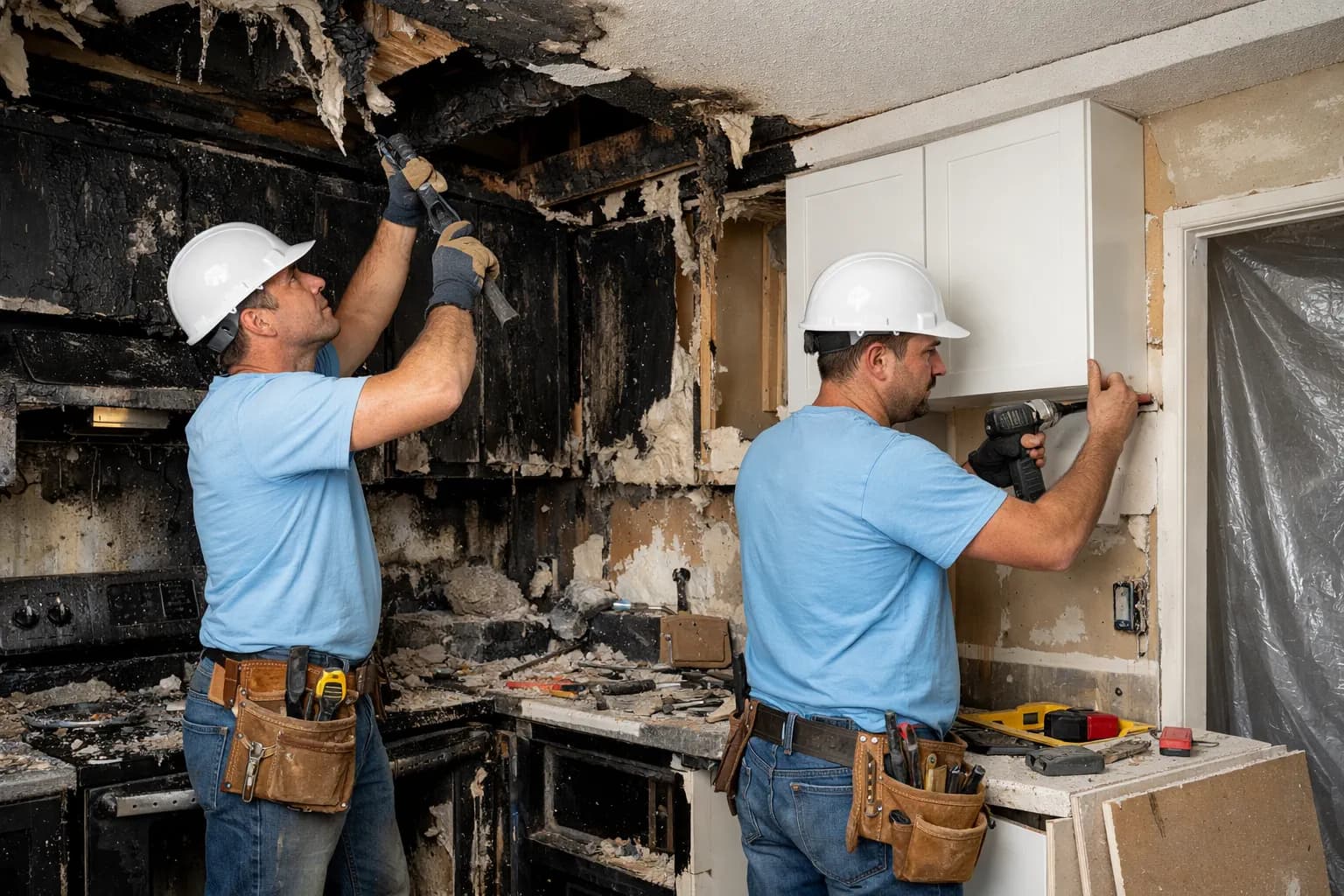
Homeowners dealing with post-fire damage
This service fits owners who need a clear repair plan after a fire and do not want smoke cleanup, structural decisions, and claim documentation split across disconnected vendors.

Fire Damage Restoration
Fire, smoke, and soot restoration aligned to insurance claims, permit requirements, and real rebuild scope.
Handy Manny's LLC supports fire-damage property owners with assessment, remediation planning, and contractor-led reconstruction while keeping insurance and scope documentation moving in the same lane.
Fire Damage Service Overview
Fire damage projects are rarely only about visible burn areas. Structural impact, smoke spread, soot contamination, and inspection requirements all influence what the property needs before it can be restored safely.
For owners in Lexington, Georgetown, and Nicholasville, the biggest risk is letting the claim and restoration scopes drift apart. Handy Manny's LLC keeps both aligned so approvals, remediation, and rebuild sequencing stay connected from day one.
Who This Service Fits
Fire loss affects different property owners in different ways, but the common need is one accountable path from assessment through final restoration.
This service fits owners who need a clear repair plan after a fire and do not want smoke cleanup, structural decisions, and claim documentation split across disconnected vendors.
Even when flames are contained, smoke and soot can spread across rooms, systems, and finishes. This page is for owners who need that secondary damage documented and restored correctly.
When the first claim estimate does not fully match structural and remediation needs, Handy Manny's LLC documents the missing scope and keeps the restoration work tied to a real build plan.
What's Included
Fire restoration succeeds when cleanup, structural work, and paperwork are treated as one project instead of isolated tasks.
Restoration Process
The objective is to move from loss assessment to approved, buildable restoration scope without losing pace to disconnected handoffs.
The first step is documenting direct fire impact plus smoke, soot, and heat-related spread so the repair scope reflects the full loss instead of only visible surface damage.
Scope decisions are organized around safety, habitability, and sequencing so cleanup, demolition, and reconstruction tasks move in the right order.
Permit requirements and claim updates are aligned with the field scope to keep approvals, inspections, and insurer conversations moving together.
Remediation and rebuild work are supervised under one contractor so communication, scheduling, and quality control stay consistent from start to final walkthrough.
Service FAQ
Many fire-related losses are covered, but coverage depends on policy terms, cause of loss, and the documented scope. The critical step is matching claim documentation to the actual restoration work required.
Smoke damage repair focuses on residue, odor, and contamination spread, while structural fire repair addresses framing, assemblies, and load-bearing elements damaged by heat or direct fire exposure.
Timeline depends on severity, permit requirements, and claim approvals. Smaller contained losses can move faster, while larger structural and smoke-remediation scopes require phased sequencing and multiple inspections.
That decision is based on safety, code requirements, cost-to-repair versus replacement, and insurer direction. The restoration scope must be documented before a realistic repair-versus-rebuild recommendation can be made.
Prioritize safety first, follow fire department and insurer guidance, and avoid starting undocumented cleanup that can hide evidence of scope. Once the site is safe, begin a formal damage assessment to define the restoration plan.
Trust And Proof
Fire-damage projects carry high cost, safety, and scheduling risk. The trust requirement is straightforward: documented scope and accountable supervision.
Fire restoration scopes are managed by a licensed, insured contractor so the assessment, remediation plan, and rebuild decisions stay accountable to one lead team.
Scope updates, photos, and trade requirements are documented for insurer review so fire-restoration approvals are tied to field conditions, not assumptions.
Smoke and soot remediation is coordinated with structural repairs under one workflow, reducing handoff risk between cleanup and reconstruction phases.
Location Relevance
Fire-damage restoration support is centered in Lexington, KY with repeat project coverage in Georgetown and Nicholasville where response speed, inspections, and claim documentation quality directly affect recovery time.
Related Paths
Use the insurance restoration route when the fire-loss scope needs supplement support and deeper claim documentation strategy.
Open PageMove into water-damage restoration when firefighting water intrusion, moisture spread, or drying coordination becomes part of the same recovery scope.
Open PageFire Damage Restoration
Request a free estimate and get a contractor-led restoration plan for fire, smoke, and soot damage in Lexington-area properties.